INTRODUCTION
The Charter of Montgomery County, Maryland (Section 302) requires the County Executive to submit a comprehensive six-year program for capital improvements, called the Capital Improvements Program (CIP), not later than January 15 of each even-numbered calendar year or the next business day if January 15th falls on a weekend or a holiday. The County Charter requires that the annual capital budget be consistent with the six-year program. In odd-numbered calendar years, the approved CIP, together with any amendments, continues to guide capital investment.
The CIP includes all capital projects and programs for all agencies for which the County sets tax rates or approves budgets or programs. The CIP includes:
- a statement of the objectives of capital programs;
- the relationship of capital programs to the County's long-range development plans;
- recommendations for capital projects and their construction schedules; and
- estimates of costs, anticipated revenue sources, and impacts of the capital program on County revenues and the operating budget.
The County Charter (Section 302) also provides that the CIP may be amended at any time. In practice, amendments to the CIP are limited to conform to the requirement for a biennial, or every other year, CIP. Criteria for amendments generally include: use of funds from external sources; projects which address significant health or safety requirements; and economic development opportunities.
This section summarizes the CIP, its six-year projections of expenditures, and the fiscal policies and funding to support them. The complete County Executive's recommended CIP is published as a separate document and may be found at https://www.montgomerycountymd.gov/omb/publications.html. The complete approved CIP can be found on the same website.
PROGRAM OBJECTIVES
Capital program goals and objectives for departments within the Montgomery County Government are provided in the program description and objectives subsections contained in the various sections of the recommended CIP document. For other government agencies (Montgomery County Public Schools, Montgomery College, Maryland-National Capital Park and Planning Commission, WSSC Water, Revenue Authority, and Housing Opportunities Commission), missions are more generally described, citing statutory authority, with agency capital programs supporting those goals. Further detail on the capital program goals and objectives for these agencies is contained in their CIP request documents, which may be obtained directly from each agency.
CAPITAL PROGRAM PLANNING
Planning Policies
Planning for capital improvements is tied to the County's continuing development and growth in population, households, and businesses. Land use master plans and sector plans for the County's geographic planning areas anticipate needs for roads, schools, and other facilities required by new or changing population. The County continues its efforts to improve the linkages between County planning activities, the CIP, and the operating budget.
General Plan and Master Plans and Sector Plans
The General Plan Refinement of FY94 recognized the importance of establishing priorities for the provision of public facilities. The Thrive Montgomery 2050 General Plan approved by the County Council on October 25, 2022, recognized the need for more housing - particularly housing that was affordable to low- and moderate-income households - improved transit services, community connections, racial equity, and sustainable communities. The CIP gives high priority to areas of greatest employment and residential density when allocating public investment. Some County master plans include phasing elements that provide guidance about the timing and sequence of capital facilities to develop a CIP that serves long-range needs. Copies of the County's General Plan, adopted master plans, and sector plans may be obtained directly from the Maryland-National Capital Park and Planning Commission (M-NCPPC).
Growth and Infrastructure Policy
Overall planning policies involve an interdependence between the CIP as a budgeting document that allocates available public resources according to County priorities and the Growth and Infrastructure Policy, the main purpose of which is to manage the location and pace of private development. The Growth and Infrastructure Policy is designed to affect the staging of development approvals, matching the timing of private development with the availability of public facilities. It identifies the need for public facilities to support private development and constrains the number of private subdivision approvals to those that can be accommodated by existing and programmed public facilities.
In order to guide subdivision approvals under the Adequate Public Facilities Ordinance (APFO), the Growth and Infrastructure Policy tests the adequacy of several types of public facilities: transportation; schools; water and sewerage facilities; and police, fire, and health services. Copies of the County's currently approved Growth and Infrastructure Policy may be obtained directly from the M-NCPPC website.
Functional Plans
Functional plans anticipate needs for government functions and services ranging from provision of water and sewerage to solid waste disposal, libraries, parks, recreation, and fire and rescue services. Other studies assess future educational, health, and human service needs. These plans are analyzed for likely new facilities or service delivery requirements and their potential operating costs which will eventually add to annual operating budgets.
Public Input
The community input process is coordinated through the Citizens Advisory Boards (CABs) for each of the five Regional Services areas. This community input process makes it easier for residents to focus on regional issues in the proposed CIP. These forums also provide residents with an opportunity to express their views on the future of the CIP in their area and to indicate their priorities for the CIP. The five local Citizens' Advisory Boards are encouraged to provide the County Executive with their development priorities during the preparation of each CIP. The County Council holds public hearings after receipt of the County Executive's recommended CIP before deliberations on the program begin. All Council work sessions are public, and residents are encouraged to attend to present their views.
Maryland Economic Growth, Resource Protection, and Planning Act
The Maryland Economic Growth, Resource Protection, and Planning Act requires local governments to review all construction projects that involve the use of State funds, grants, loans, loan guarantees, or insurance for consistency with existing local plans. The County Executive or the requesting agency affirms that all projects which are expected to receive State financial participation conform to relevant local plans. This language appears in the "Disclosures" portion of the relevant project description forms.
County Council and Planning Board Review
During the County Council review process, the Planning Board provides comments to the County Council regarding conformance with local plans, and a final determination as to consistency of projects with adopted County plans is made by the County Council. The County Council adopts the CIP and approves a list of applicable State participation projects.
Fiscal Policies
Prior to considering specific projects for inclusion in the CIP, Montgomery County develops projections of total resources available to the County as a whole, and to the CIP as a subset of the whole. A variety of assumptions underpin these projections.
Economic Assumptions
Revenue projections depend largely on assumptions regarding economic activity, including employment, income, inflation, interest rates, construction, home sales, and other economic conditions.
Demographic Assumptions
The CIP is based on demographic assumptions based on data from Moody's Analytics and Woods & Poole Economics and are based on fiscal and economic data and analyses used or prepared by the Department of Finance. This forecast predicts that the County will continue to experience population growth. Besides general population changes, demographic forecasts anticipate a gradual decline in public school enrollment, mirroring statewide enrollment trends.
Debt Capacity
To maintain its AAA bond rating, the County considers the following guidelines in deciding how much additional County general obligation debt may be issued in the six-year CIP period.
- Total debt, both existing and proposed, should be kept at about 1.5 percent of full market value (substantially the same as assessed value) of taxable real property in the County.
- Required annual debt service expenditures should be kept at about 10 percent of the County's total tax-supported operating budget. The tax-supported operating budget excludes proprietary funds and grants.
- Total debt outstanding and annual amounts issued, when adjusted for inflation, should not cause real debt per capita to rise significantly.
- The rate of repayment of bond principal should be kept at existing high levels and in the 60-75 percent range during any 10-year period.
- Total debt outstanding and annual amounts proposed should not cause the ratio of per capita debt to per capita income to rise significantly above about 3.5 percent.
The debt capacity schedule is displayed later in the Debt Service section.
Spending Affordability Assumptions
The Charter of Montgomery County, Maryland (Section 305) requires that the Council adopt spending affordability guidelines for the capital and operating budgets. Spending affordability guidelines for the CIP have been interpreted in County law to be limits on the amount of general obligation debt and Park and Planning debt that may be approved for expenditure in the CIP. Spending affordability guidelines are adopted in odd-numbered calendar years and limit the amount of general obligation debt that may be approved for the first year, the second year, and for the entire six years of the CIP. Similar provisions cover the bonds issued by M-NCPPC.
The Montgomery and Prince George's County Councils adopt one-year spending limits for WSSC Water. These spending control limits include guidelines for new debt and annual debt service.
General Obligation Debt Limits
General obligation debt usually takes the form of bond issues. General obligation debt pledges general tax revenue for repayment. Montgomery County has maintained a AAA rating, the highest quality rating available, for its general obligation bonds. This top rating by Wall Street rating agencies, enjoyed by very few local governments in the country, assures Montgomery County of a ready market for its bonds and the lowest available interest rates on that debt.
Impact of Capital Program on the Operating Budget
Capital improvement projects generate future operating budget costs in the following ways: (1) debt service; (2) current revenues that fund projects not eligible for debt financing; (3) PAYGO which offsets the need to issue debt; and (4) changes to the operating budget to support new or renovated facilities.
Debt Service
The annual payment of principal and interest on general obligation bonds and other long-term and shorter-term debt used to finance roads, schools, and other major projects is included in the operating budget as a required expenditure. The FY27 tax-supported debt service, as displayed later in the Debt Service section, is approximately $483.5 million.
Current Revenue and PAYGO
Certain CIP projects are funded directly with County Current Revenues to avoid costs of borrowing. These amounts are included in the operating budget as specific transfers to individual projects within the capital projects fund. PAYGO, or "pay-as-you-go" funding, is an additional amount included in the operating budget as a direct bond offset to reduce the amount of borrowing required for project financing. The FY27 tax-supported Current Revenue and PAYGO are approximately $89.3 million and are displayed in the Schedule A-3.
Operating Budget Impacts (OBI)
The construction of government buildings and facilities usually results in new annual costs for maintenance, utilities, and additional staffing required for facility management and operation. Whenever a new or expanded facility involves program expansion, as with new school buildings, libraries, or fire stations, the required staffing and equipment (principals, librarians, fire apparatus) represent additional operating budget expenditures.
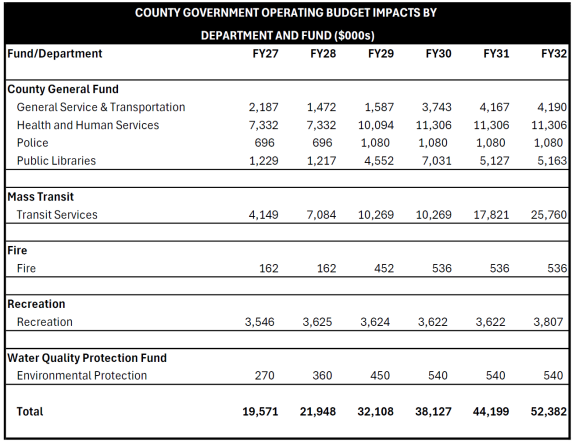
The CIP includes analysis of these operating budget impacts to aid in review and decisions on the timing of public facilities and to more clearly show what a new building or road will cost in addition to its construction costs and any required debt service. The project description forms published in the Recommended FY27-32 CIP in January display operating budget impacts of individual projects where applicable. The following chart summarizes the impact of the Recommended FY27-32 CIP on the operating budget expenditures of the related departments.
PROJECT COST PROJECTIONS
Departments and agencies estimate the cost of each proposed capital project in current dollars. For the most part, County government departments use contracted cost estimators to develop project costs, and those estimates are reviewed and verified by County staff. Recent cost changes for construction commodities are included, and projects are escalated to the mid-point of construction. Inflation is estimated separately, and funds are set aside to allow for inflation-driven cost increases in later years. During each even-numbered calendar year, all existing and proposed projects are reviewed centrally for changes to cost, scope, and timing, and adjusted as necessary.
The Charter of Montgomery County, Maryland (Section 307) provides for supplemental appropriations to address interim project cost increases. Unappropriated resources are set aside during the fiscal planning process to fund potential cost increases or for new projects that address urgent needs.
REVENUE SOURCES
The major revenue sources for the Capital Improvements Program are described in the Fiscal Policy section of the County Executive's Recommended CIP. There are four major types of revenue sources for the capital improvements program: current revenues (including PAYGO and recordation taxes); proceeds from bonds and other debt instruments; impact taxes paid to support increased transportation and school capacity needed as a result of development; and grants, contributions, reimbursements, or other funds from intergovernmental and other sources. In some cases, where both a public and a private goal may be achieved, the County enters partnerships with the private sector to finance and construct public facilities.
The specific funding sources for all expenditures are identified on each individual capital project description form.
Current Revenues
Current revenues from the General Fund are used for designated projects which involve broad public use and which fall outside any of the specialized funds. Generally, current revenues are used for the planning of capital projects.
PAYGO is current revenue set aside annually in the operating budget, but not appropriated. PAYGO is used to replace bonds for debt-eligible expenditures ("pay-as-you-go" financing) or when projects are not debt eligible or not eligible for tax-exempt financing. The County generally allocates PAYGO of at least ten percent of general obligation bonds planned for issue each year.
Bond Issues and Other Public Agency Debt
Bonds are used to spread the cost of construction of a public facility over time, such that those who benefit from it over time share in the costs. The County government and four of its agencies are authorized by State law and/or County Charter to issue debt to finance CIP projects. This debt may be either general obligation or self-supporting debt.
County government general obligation bonds are issued for a wide variety of functions such as transportation, public schools, the community college, public safety, and other programs. These bonds are legally-binding general obligations of the County and constitute an irrevocable pledge of its full faith and credit and unlimited taxing power. The money to repay general obligation debt comes primarily from General Fund revenues, except that debt service on general obligation bonds, if any, issued for projects of Parking Districts, Liquor, or Solid Waste Funds is supported from the revenues of those enterprises.
M-NCPPC is authorized to issue general obligation bonds, also known as Park and Planning bonds, for the acquisition and development of local and certain special parks and advance land acquisition, with debt limited to that which are supportable within tax rates established for the commission.
County revenue bonds are bonds authorized by the County to finance specific projects such as parking garages and solid waste facilities, with debt service to be paid from pledged revenues received in connection with the projects. Proceeds from revenue bonds may be applied only to costs of projects for which they are authorized. They are considered separate from general obligation debt and do not constitute a pledge of the full faith and credit or unlimited taxing power of the County.
County revenue bonds have been used in the Bethesda and Silver Spring Parking Districts, supported by parking fees and fines together with parking district property taxes. County revenue bonds have also been issued for County Solid Waste Management facilities, supported with the revenues of the Solid Waste Disposal system.
The Montgomery County Revenue Authority has authority to issue revenue bonds and to otherwise finance projects through notes and mortgages with land and improvements serving as collateral. These are paid through revenues of the Authority's several enterprises, which include golf courses and the Montgomery County Airpark.
The County government also uses the Revenue Authority as a conduit for alternative CIP funding arrangements for swim centers and previously for the construction of the Montgomery County Conference Center. The County has entered into long-term leases with the Revenue Authority, and the County lease payments fund the debt service on these Revenue Authority bonds.
Other specialized bonds are used to finance a variety of public infrastructure, including water distribution and sewage collection lines and required support facilities, stormwater management, and affordable housing. These bonds are paid from non-tax sources including user charges and mortgages, which also cover all operating costs.
Intergovernmental Revenues
CIP projects may be funded in whole or in part through grants, matching funds, or cost sharing agreements with the Federal government, the State of Maryland, the County's incorporated municipalities, or regional consortia such as the Washington Metropolitan Area Transportation Authority, WSSC Water, and the Washington Area Sewer Authority.
Federal Aid. Major projects that involve Federal aid include Metro, commuter rail, interstate highway interchanges, bus rapid transit, bridges, and various environmental construction or planning grants. Most Federal aid is provided directly to the State, and then redistributed to local jurisdictions.
Community Development Block Grant (CDBG) funds are received through annual formula allocations from the U.S. Department of Housing and Urban Development in response to a County application and are used for neighborhood improvements and facilities in areas where there is significant building deterioration, economic disadvantage, or other need for public intervention in the cycles of urban growth and change.
State aid includes grants, matching funds, and reimbursements for eligible County expenditures for local projects in public safety, environmental protection, health and human services, courts and criminal justice, transportation, libraries, parkland acquisition and development, community college, and public school construction.
Municipal Financing. Some projects with specific benefits to an incorporated municipality within the County may include funding or other financing from that jurisdiction. Incorporated towns and municipalities, specifically Rockville, Gaithersburg, and Poolesville, have their own capital improvements programs and may participate in County projects where there is shared benefit.
Other Revenue Sources
The use of other revenue sources to fund CIP projects is normally conditioned upon specific legislative authority or project approval, including approval of appropriations for the projects. Approval of a project may be contingent upon actual receipt of the revenues planned to fund it, as in the case of private contributions that are not subject to law or agreement.
EXAMPLES OF CAPITAL PROJECTS
The CIP addresses the County's needs for basic infrastructure, education, transportation, and other critical facilities in the following ways.
SPOTLIGHT ON SIGNATURE INITIATIVES
Building Bus Rapid Transit System
- Significantly advance the bus rapid transit (BRT) program leveraging new special taxing district revenues, Federal and State aid, and general obligation bonds to fund the design and construction of the following corridors:
- Veirs Mill Road;
- MD 355 Central from Rockville to Germantown;
- MD 355 South from Bethesda to Rockville;
- MD 355 North from Germantown to Clarksburg;
- New Hampshire Avenue from the District of Columbia line to Colesville; and
- U.S. 29 Phase 2, adding additional transit lane dedication to the corridor.
- Recommend funding for the design and construction of the Bus Rapid Transit: MD 355 Lakeforest Transit Center.
- Support for study, conceptual design, and construction of a new transit bus depot to support growth of the Ride On bus fleet.
- Maintain annual funding in the Bus Priority Program to enhance Countywide bus system performance.
- Construct a hydrogen generation and fueling site to provide green hydrogen fuel for Ride On buses.
- Continue to support the construction of a mezzanine for the south entrance of the Bethesda Metrorail station in coordination with the Purple Line project.
- Provide oversight and financial support for the Purple Line project, which will provide significant economic and mobility benefits.
- Continue efforts to improve the condition of Ride On bus stops.
- Add funding to improve the County's Park and Ride lots.
- Connect residents across the County to jobs, entertainment, and healthcare with reliable, accessible transit.
Preserving & Increasing Affordable Housing
- Fund the Affordable Housing Acquisition and Preservation project to increase and preserve the stock of affordable housing in Montgomery County.
- Recommend continued support of the Nonprofit Preservation Fund project to preserve existing affordable housing in developments at risk of rent escalation to higher market rents.
- Continue support of the Revitalization for Troubled and Distressed Common Ownership Communities project to provide financial and technical support for aging neighborhoods with homeowner and condominium associations to address delayed maintenance and rehabilitation of their common areas.
- Continue support of the Affordable Housing Opportunity Fund project to leverage a public-private commitment of funds to preserve affordable housing developments.
Fighting Climate Change
- Allocate $82.0 million to begin implementation of the Comprehensive Flood Management Plan to construct flood mitigation improvements in watersheds throughout the County, with feasibility studies for flood mitigation projects within the Sligo Creek watershed beginning in FY27.
- Invest $36.9 million in funding for projects to enhance energy conservation in County-owned facilities.
- Support clean energy for the County's bus fleet by allocating $9.8 million in funding to expand the hydrogen generation and fueling facility in Gaithersburg.
- Extend BRT service with the purchase of zero-emission buses; replace 234 diesel and natural gas Ride On buses with zero-emissions buses in FY27-32 with the goal of a transition to a 100 percent zero-emissions fleet by 2035.
- Enhance funding for parking and fueling infrastructure to support zero-emission bus fleet expansions.
Improving Economic & Community Development
- Invest $50.0 million to advance planning and design for the University of Maryland Institute for Health Computing (IHC) building at the North Bethesda Metro to help establish this location as a centerpiece for the creation of a new life science and technology business hub.
- Continue the public-private partnership to develop the White Oak Science Gateway life science mixed-use development.
- Invest in infrastructure to support redevelopment at the North Bethesda Metro station.
- Fund the design and construction of retail space at the Wheaton M-NCPPC Headquarters building.
Advancing Racial Equity & Social Justice
- Allocate funding for affordable housing, transit, pedestrian safety, education, culture and recreation, and economic development projects that can reduce racial disparities and inequities.
- Projects with the potential to advance racial equity and reduce disparities in Montgomery County include:
- 4th District Police Station
- Bus Rapid Transit on MD 355, Veirs Mill Road, and US-29 Phase-2, and New Hampshire Avenue
- Bus Rapid Transit Lakeforest Transit Center
- Parklawn Entrance Bridge
- Valleywood Drive Bridge
- North High Street Extended
- Burtonsville Park and Ride Improvements
- Bicycle-Pedestrian Priority Area Improvements - Purple Line
- Bicycle-Pedestrian Priority Area Improvements - Wheaton
- Shady Grove Westside Library
- Recreation Facilities Refurbishment - Centers
- Support the deployment of Montgomery County's residential high-speed internet service network with funding for affordable housing developments to assist lower income residents with access to high quality broadband services.
A GREENER COUNTY
Recycling and Resource Management
- Create a new project for maintenance and repairs of the Shady Grove Processing Facility and Transfer Station. This project shifts capital-eligible spending from the operating budget to the capital budget to relieve pressure on the Disposal Fund's debt service coverage ratio.
- Sustain safe and reliable operation through upgrades to the Recycling Center, which will allow the County to process 100 percent of the material it generates.
- Improve the capture of methane, a powerful greenhouse gas, from the decommissioned Gude Landfill, and install a toupee cap to prevent groundwater contamination.
- Upgrade the leachate plant at the decommissioned Oaks Landfill which has reached the end of its useful life.
Stormwater Management
- Recommend significant investments to address flooding throughout the County.
- Enhance funding for small-scale repair and restoration work to prevent minor deficiencies from becoming larger, more costly projects in the future.
- Utilize Maryland Water Quality Revolving Loan funds to reduce program costs through lower-interest financing.
- Leverage Water Quality Bonds for projects that are ineligible for low-interest loans.
- Program funding for installation of new stormwater management facilities and retrofit old stormwater controls to prevent property damage, improve water quality, and protect habitat.
- Repair major structures on public and private stormwater facilities accepted into the County's maintenance program.
Maryland-National Capital Park and Planning Commission
- Recommend $280.7 million in funding for the FY27-32 CIP.
- Allocate $2.5 million for the new Parkway Improvements project to support maintenance of park roads, with resources shifted from the Resurfacing Park Roads and Bridge Improvements project in the Department of Transportation.
- Fund the construction and renovation of hard surface trails, enhancing community connectivity, trail amenities, and signage.
- Support ongoing maintenance of the park system and address life-cycle infrastructure needs.
THRIVING YOUTH AND FAMILIES
Montgomery County Public Schools (MCPS)
- Allocate $2.1 billion to support school construction - the County Executive's highest priority. This is the largest MCPS CIP ever recommended. MCPS represents 28.70 percent of all spending in the CIP.
- This recommendation assumes $378.0 million in State aid for school construction which includes $326.1 million in traditional State aid and EGRC, $50.4 million from the Built To Learn Act program, and $1.5 million in other State funding.
- Despite construction cost increases, significant revenue reductions in the first four years of the CIP, and a return to traditional State aid funding levels ($42 million to $45 million a year), the recommended MCPS CIP increases funding by $292.7 million in the first four years of the CIP.
- Support the Blueprint for Maryland's Future to expand full-day Pre-K education. If funded, MCPS's request would fund the renovation of the Emory Grove Center to make it the permanent location for the Upcounty Early Childhood Center.
- Continue to support funding for MCPS's Countywide infrastructure and systemic projects such as Heating, Ventilation and Air Conditioning (HVAC), Roof Replacement, Planned Lifecycle Asset Replacement (PLAR), ADA Compliance, Emergency Replacement of Major Building Components, as well as others.
- Fund an elementary school boundary study through the Facility Planning project to assist MCPS manage declining enrollment and future capital needs at the school level.
- Support, through the Outdoor Play Space and Athletic Infrastructure project, the replacement of sport fields with natural grass for health and environmental reasons.
Montgomery College
- Continue support to establish a fourth college campus in East County.
- Recommend funding the Germantown Student Affairs Building Renovation and Addition beginning in FY31.
- Enhance funding for the Collegewide Library Renovations to take advantage of State-allowed escalation and mitigate inflationary costs.
- Continue construction funding for the Germantown Student Services Center.
- Add funding to support a new Collegewide Security Systems Project.
Public Libraries
- Fund the construction of the Clarksburg Library to serve the growing community with convenient library resources.
- Finance the design and construction of a new Shady Grove West Library that is part of a housing development next to the Shady Grove Metro station.
- Refurbish the following libraries over the FY27-32 CIP cycle.
- Brigadier General Charles E. McGee Library in Silver Spring
- Damascus Library
- Gaithersburg Library
- Olney Library
- Rockville Memorial Library
- Twinbrook Library
- Add funds to ensure adequate support to complete meaningful renovations to the Chevy Chase Library.
- Continue implementation of the 21st Century Library Enhancements project that will allow Public Libraries to respond to customer demands and library trends that require changes in the equipment and related furnishings of library buildings.
Health and Human Services
- Include funding for High School Wellness Centers providing somatic, mental health, and positive youth development services, and Connections to Wellness Centers supporting mental health and positive youth development services.
- Maintain funding for Linkages to Learning sites at Eastern Middle School and two future schools.
- Support planning, design, and construction of a diversion center to provide crisis stabilization, referral, and follow-up services to adult County residents, while reducing the burden on hospital emergency rooms, first responders, and the criminal justice system.
- Fund the planning and construction of an Affordable Living Quarters facility so that individuals can end their experience with homelessness.
- Support the renovation of childcare facility playgrounds, accessibility remediation, and replacement.
Recreation
- Allocate funding for the construction of a natural grass field at North Potomac Community Center.
- Program funds for design and construction of the Western County Recreation Center to serve the Town of Poolesville and the neighboring communities in Western Montgomery County.
- Support development of the Wheaton Arts and Cultural Center.
- Bolster funding for the Recreation Facilities Refurbishment projects to ensure that indoor pools, outdoor pools, and recreation center facilities are refurbished through repair or replacement of facility components.
- Enhance funding to the Swimming Pools Slide Replacement project to ensure safe pool operations.
- Boost funding to the Recreation Asset Replacement project to replace assets such as bleachers, kitchens, marquees, and partitions to ensure recreational assets are maintained.
EASIER COMMUTES
Pedestrian & Bicycle Facilities
- Allocate $4.3 million for curb and sidewalk replacement to connect schools and employment centers to help people safely reach their destinations.
- Leverage Federal funding to construct secure bike parking facilities in Silver Spring and Bethesda. This project will add secure bike parking facilities at the Silver Spring Transit Center and the Bethesda Metro station, both of which are served by the Metro Red Line and will soon be served by the Purple Line light rail.
- Received $3.3 million in State funding for the Bicycle-Pedestrian Priority Area Improvements (BiPPA) - Purple Line project; the additional funding will provide more sidewalk connections and additional sidewalk repairs in FY27 and FY28.
- Improve the County's overall accessibility for pedestrians and bikeways and contribute to the Vision Zero goal of reducing deaths and serious injuries on County roads with the following projects.
- Fenton Street CycleTrack
- Bowie Mill Road Bikeway
- Bicycle-Pedestrian Priority Area Improvements - Purple Line (BiPPA Purple Line)
- MD 355-Clarksburg Shared Use Path
- Tuckerman Lane Sidewalk
- MacArthur Boulevard Bikeway Improvements
- MD 198 Sidewalk Improvements
- Sandy Spring Bikeway
- Dale Drive Shared Use Path and Safety Improvements
- Increase funding to the Bicycle-Pedestrian Priority Area Improvements - Wheaton CBD project to construct additional sub-projects, including construction and land cost increases due to expanding scope to include widening and reconstruction of existing sidewalk, tightening intersection turning radii, and updating design for floating bus stops per the Planning Board recommendation and community feedback for the Amherst Avenue Bikeway project.
- Continue funding for the Silver Spring Green Trail and increase funding to support completion of the Capital Crescent Trail, two Purple Line-related projects.
Bridges & Roads
- Accelerate delivery of road projects including Observation Drive Extended and Summit Avenue Extended leveraging special taxing district revenues.
- Leverage $37.8 million in Federal funding for County bridges. New bridge projects include: Burnt Hill Road, Greentree Road, Parklawn Entrance, Valleywood Drive, and Zion Road.
- Boost investment in existing infrastructure for the maintenance and rehabilitation of roads, bridges, and sidewalks.
- Include funding for North High Street to increase safety and connectivity with the Olney Town Center.
- Complete construction of a new roadway between Spencerville Road (MD 198) and the School Access Road in Burtonsville.
- Increase funding for the Bridge Design and Bridge Preservation programs, as well as the Brink Road, Brookeville Road, Dorsey Mill Road, Garrett Park Road, Redland Road, and Schaeffer Road bridge projects.
SAFE NEIGHBORHOODS AND VISION ZERO
Transportation
- Recommend $3.0 billion in funding over six years to support critical transportation infrastructure: mass transit, highway maintenance, pedestrian facilities/bikeways, traffic improvements, bridges, parking, and roads.
- Add funding for Forest Glen Passageway, a grade-separated connection under Georgia Avenue to improve pedestrian access to Forest Glen Metro supported by new special taxing district revenues.
- Provide Montgomery County residents with easier commutes, new transportation options, more choices on how to travel, and greater safety.
- Enhance funding to expand the streetlighting project to increase safety around bus stops; advance the design and construction of the U.S. 29 Streetlighting project, with $2.8 million in grant allocations over the next two years.
- Increase funding to maintain and rehabilitate our roads and sidewalks, including the rehabilitation, resurfacing, and permanent patching of primary/arterial and residential/rural County roads.
- Install and reconstruct traffic signals across Montgomery County to improve pedestrian, bicycle and motor vehicle safety, as well as advance mobility.
- Increase funding to install and convert streetlights across Montgomery County to improve safety, reduce energy consumption, and contribute to crime reduction.
- Continue efforts to advance neighborhood traffic calming by installing traffic control devices and reducing posted speed limits to enhance community safety.
Police
- Begin design and program placeholder funding of $45 million for a new 4th District Police Station to replace the existing obsolete station that does not meet the needs of modern policing.
- Program funding to support the second phase of the Public Safety Communications Center building system renovation project.
- Replace 1,346 regular body armor units and 65 ballistic Special Weapons and Tactics (SWAT) team body armor vests.
Correction and Rehabilitation
- Program funding to design and construct a new Justice Center. The new facility will include a central processing/detention component to support processing new arrestees and detaining remanded individuals for up to 72 hours. The facility will be constructed adjacent to the planned Diversion Center to maximize diversion and deflection opportunities.
- Recommend funding for a Montgomery County Correctional Facility Refresh project to include medical unit modifications and remediation of clogged vents in inmate cells to address health and life safety needs. The project also provides for paint and carpet replacement throughout the facility.
Fire and Rescue Service
- Recommend $44.2 million in funding for the continued design and construction of a new White Flint Fire Station to house units currently operating out of Rockville Station 23 that supports the North Bethesda community. This project will include enhancements to achieve net zero construction.
- In support of critical apparatus replacement needs, recommend a steady stream of CIP funding for the apparatus replacement program. The following units are anticipated to be replaced over the six-year period: 6 aerial trucks, 40 ambulances, 15 engines, 3 all-wheel drive brush engines, 3 rescue squad/hazmat units, 3 tankers, and 1 auxiliary hazardous materials response vehicle.
- Recommend funding to purchase self-contained breathing apparatus that are reaching the end of their useful life and support an essential part of firefighters' personal protective equipment.
- Fund planning for the Rockville Fire Station 3 Renovation project.
- Design and construct female facility improvements at Silver Spring Fire Station 16 to expand and improve locker, shower, and restroom facilities to appropriately accommodate Montgomery County Fire and Rescue Service personnel.
- Enhance funding for heating, ventilation, and air conditioning (HVAC)/electrical replacement to preserve the buying power of important level of effort maintenance projects.
EFFECTIVE, SUSTAINABLE GOVERNMENT
WSSC Water
- Recommend full funding of the agency's $1.77 billion request for the FY27-32 CIP.
- Maintain development of capital projects aimed to address long-term issues in water and sewer management.
- Continue funding capital projects whose purpose is to support the extensive water and sewer infrastructure and numerous support facilities, including addressing regulatory changes, regulatory mandates, health and safety issues and business risk exposure.
- Completed the Piscataway Bio-Energy project, the largest and most technically advanced project ever constructed by WSSC Water, to use innovative technology to recover resources and produce green energy.
- Expand the consolidated Laboratory Division building and replace equipment in the building to accommodate increased workload.
- Replace and upgrade assets at the WSSC Water Support Center.
- Continue to address the consent decrees related to the Potomac Water Filtration Plant to allow WSSC Water to meet new discharge limitations.
Technology
- Add funding for a new Next Generation Technology Refresh project to provide lifecycle technology upgrades to County infrastructure.
- Support the Montgomery Connects project to help lower income residents access high-quality broadband services. Funding will primarily support the deployment of Montgomery County's residential high-speed internet service network for affordable housing developments.
- Fund the County Building Network Wiring project to ensure continuity in network wiring and equipment upgrades in County-owned buildings to eliminate bottlenecks and allow County users to fully utilize the FiberNet system.
- The County Radio Life Cycle Replacement project, which is the County's critical infrastructure communications network, will continue the phased replacement of outdated voice radio systems used by County agencies including Police, Fire and Rescue, Sheriff, Correction and Rehabilitation, Transportation, and the Maryland-National Capital Park and Planning Commission.
General Government
- Enhance funding for ADA Compliance, Heating, Ventilation and Air Conditioning (HVAC) Replacement: Montgomery County Government, Roof Replacement, HVAC Replacement: Fire Stations, and ABS Conveyor System Upgrade projects.
- Recommend funding of $5.8 million for elevator improvements in the Judicial Center North Tower in FY28 and FY29.
Revenue Authority
- New projects to install electric charging infrastructure for golf carts at Little Bennett Golf Course and for stormwater overflow in parking areas at Crossvines facility.
EXPLANATION OF THE CHARTS WHICH FOLLOW
Expenditure Summary by Category and Sub-Category
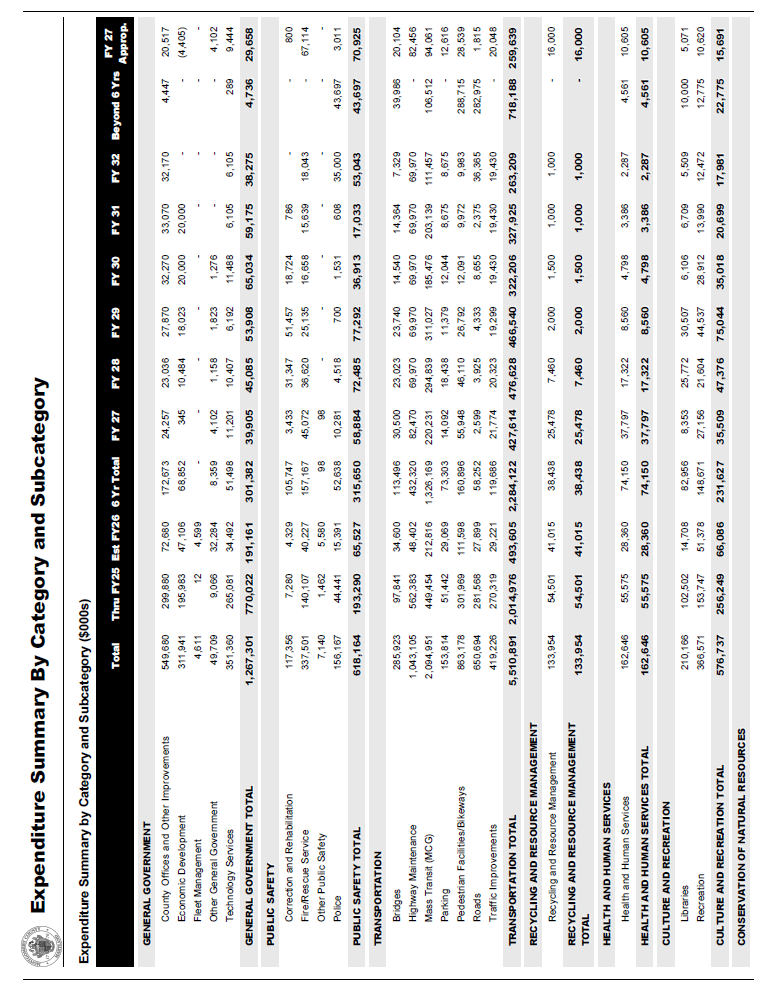
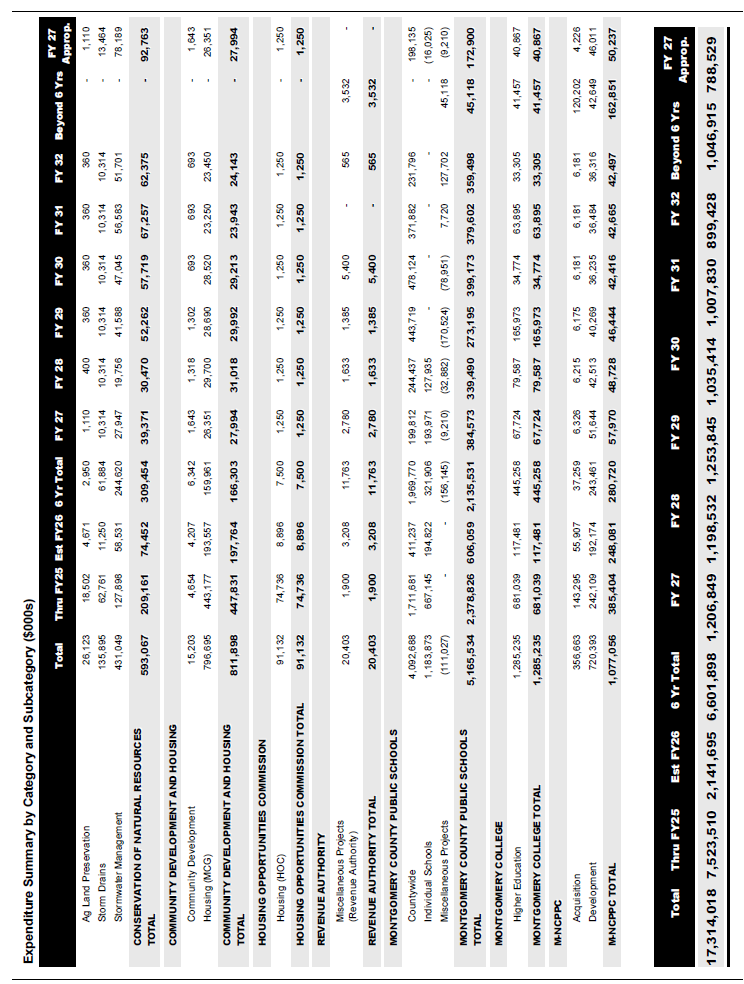
The program expenditure summary report for the County Executive's Recommended FY27-32 CIP, as recommended in January, is included after the chapter narrative. The County Executive's Recommended FY27-32 CIP contains project description forms for each capital project which include a description, programmed expenditures, and funding sources.
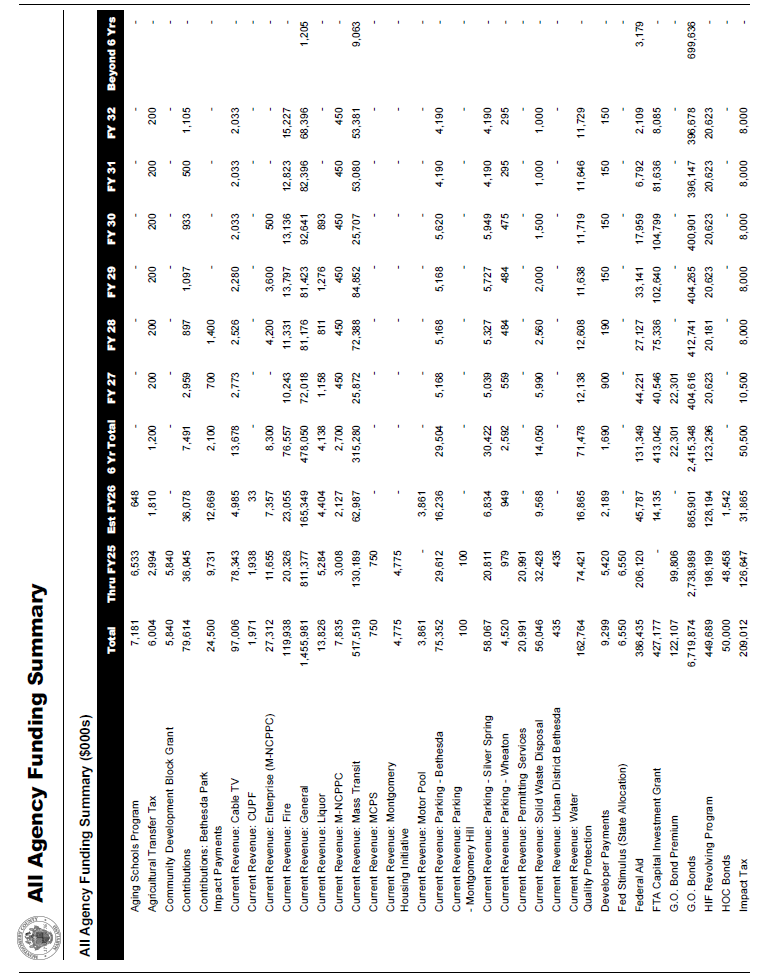
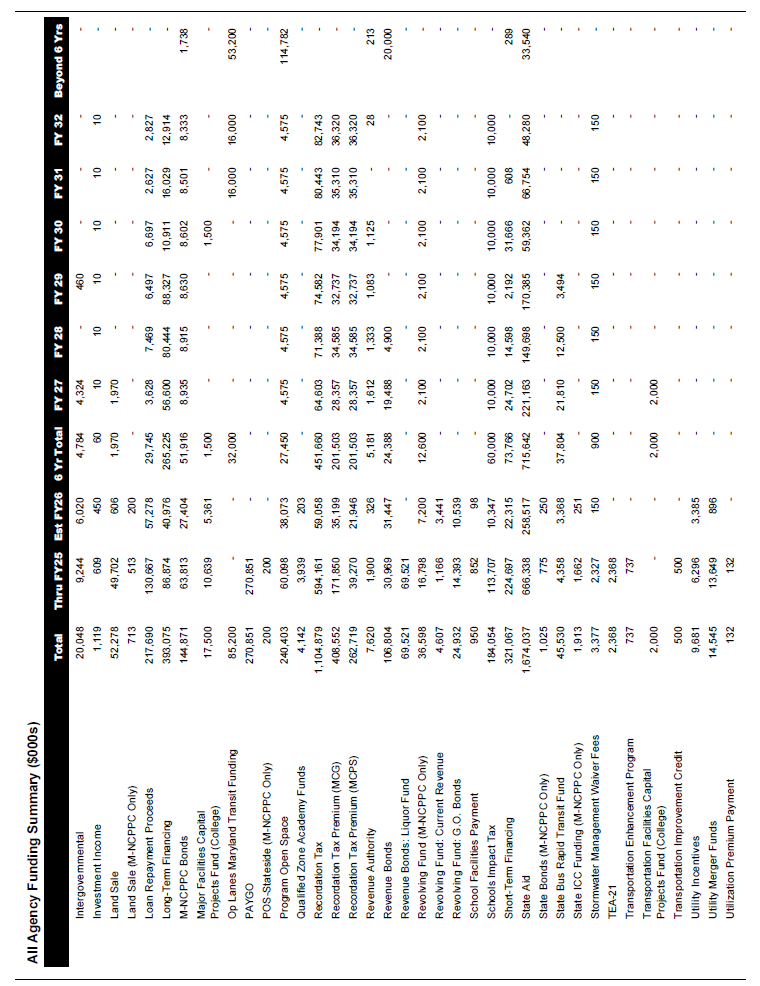
All Agency Funding Summary
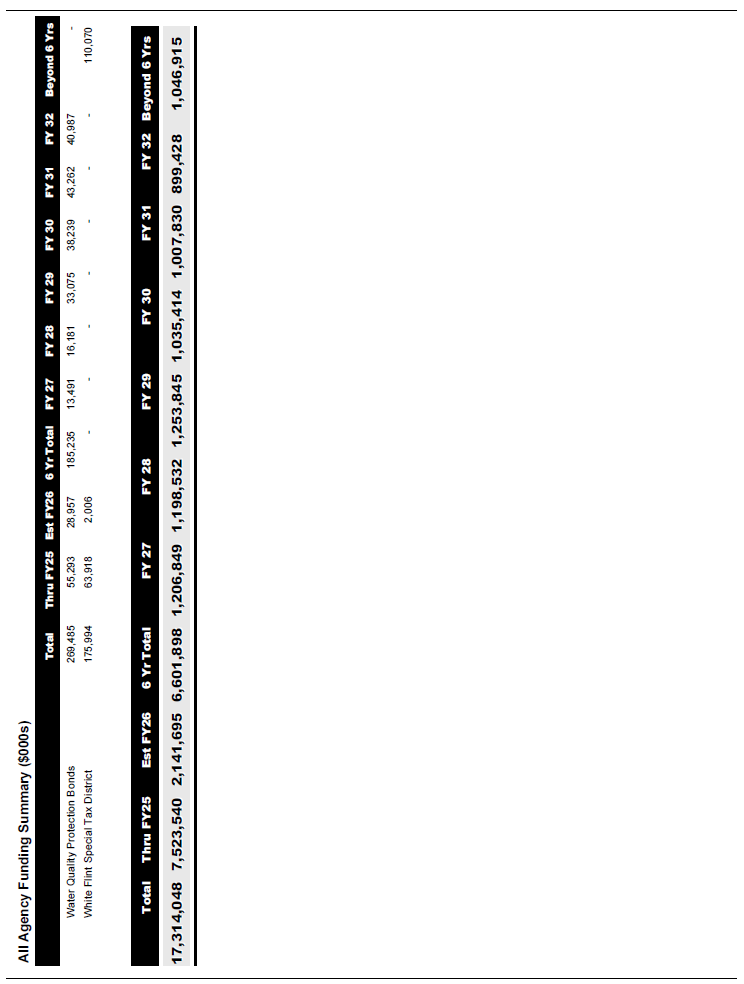
The summary report listing funding from all sources for the County Executive's Recommended FY27-32 CIP, as recommended in January, is included after the Expenditure Summary by Category and Subcategory report. The County Executive's Recommended FY27-32 CIP contains project description forms for each capital project which include a description, programmed expenditures, and funding sources.